
Finding Bloomingdale Residents
Begin with the fact least likely to change. For a current address, the DuPage County Property Lookup can return a parcel identification number, the physical property address, a billing name, a legal description, tax data, and transfer links. For one person, use a full name plus an address, date of birth, or time period. The DuPage voter tool and court index have different rules and different blind spots, so matching names alone is weak evidence.
The residents directory is a route to source records, not a household census. Owners may receive tax mail elsewhere. Renters may never appear on a parcel card. Voter details are limited, court files may be sealed, and vital certificates have eligibility rules. Record the date and exact spelling from each result. A second source should confirm the same person, parcel, or era before you rely on it.
- Search the county property roll by street address or billing name, then save the ten-digit PIN.
- Use the county election address tool to check the precinct, polling place, and districts tied to the address.
- Carry the name, address, or PIN into the Recorder index and inspect document dates and party roles.
- For an older household, ask the library for maps, directories, real-estate files, obituaries, and newspapers from the right year.
- When the web stops, contact the custodian or file a focused Illinois FOIA request for an existing municipal record.
Bloomingdale Resident Record Keepers
Bloomingdale is not the DuPage County seat. Village records stay with Village Hall, while deeds, assessments, elections, court files, and most certificates lead to separate county offices in Wheaton. The Recorder identifies parties to land instruments. The Supervisor of Assessments connects parcels to billing names and physical addresses. The Election Division supplies address and district searches. Each office answers a narrower question than a residents directory, and one office cannot certify another custodian's record.
Bloomingdale Property Search Fields
The county portal offers more than a simple owner box. It accepts a PIN, address, billing name, or map route. A parcel card separates PROPADDR, the situs or physical parcel address, from BILLADDR, the place where tax mail goes. Save both. A different billing address may identify an owner who lives elsewhere, but it does not establish who occupies the Bloomingdale property.
| Search route | Useful result | Key limit |
|---|---|---|
| PIN | Exact parcel and tax card | Use all ten digits |
| Address | Situs and candidate parcels | Unit and street form matter |
| Billing name | Tax-recipient match | Not proof of residence |
| Map | Parcel in spatial context | Boundary is not a household list |
The sample parcel card in the research also exposes tax year, legal description, transfer history, and links toward Recorder material. Those fields let the same parcel be followed when a street label changes.
The DuPage Property Lookup screen shows the official starting routes.
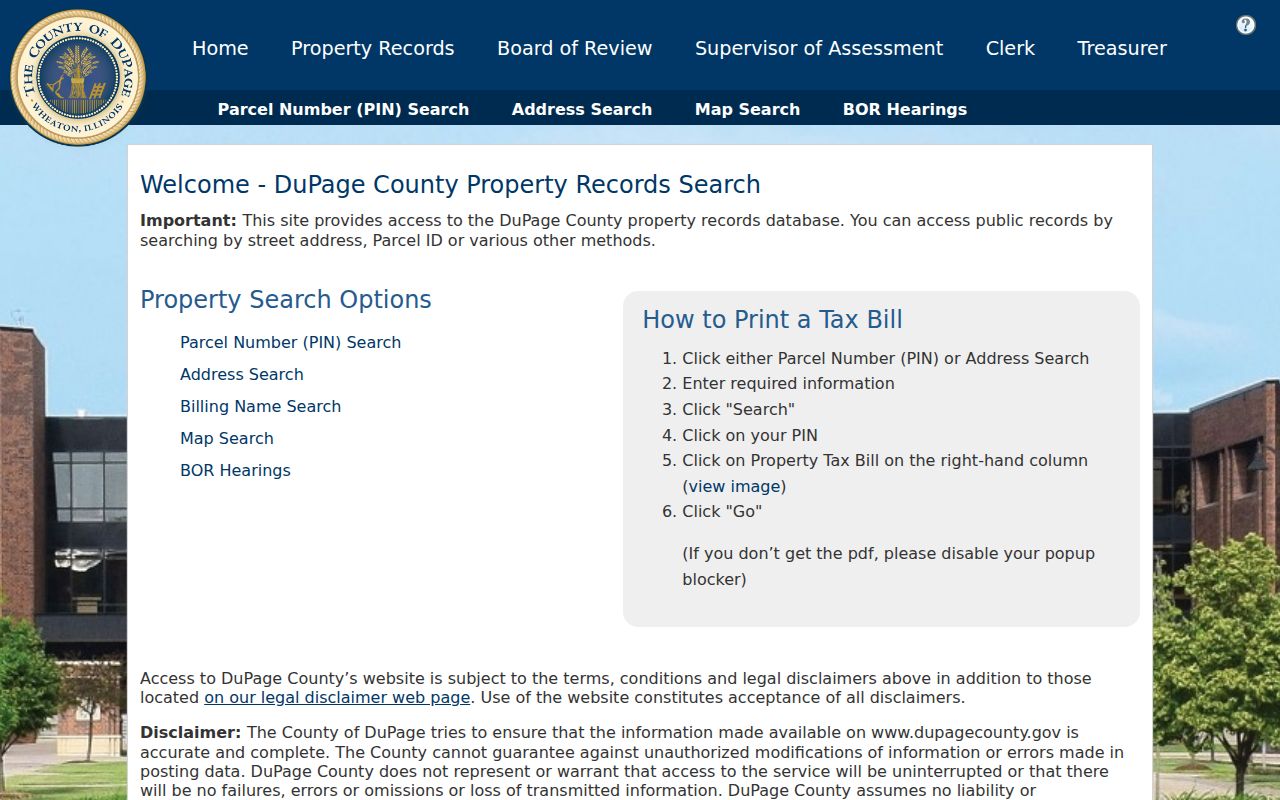
The screen confirms why an address search and a billing-name search should be treated as separate tests.
Bloomingdale Deeds Since 1961
The DuPage Recorder search accepts party name, street, PIN, document group or type, and date range. The online index and images begin March 16, 1961. That is a digital boundary, not the start of Bloomingdale land history. Recorder office research reaches 1839 to the present, while computer name searches begin in 1961, PIN searches in 1985, and address searches in 1995. Plats reach into the 1800s.
- Grantor
- The party transferring an interest.
- Grantee
- The party receiving that interest.
- PIN
- The county's parcel identification number.
- Plat
- A recorded drawing that defines lots, blocks, or subdivisions.
Search a current grantee, open the deed, then move backward through prior grantors. If an address produces no older hit, retry the legal description, subdivision, and party names. Visit or contact the Recorder when the trail crosses an online cutoff.
The Recorder index capture shows its separate property and party controls.
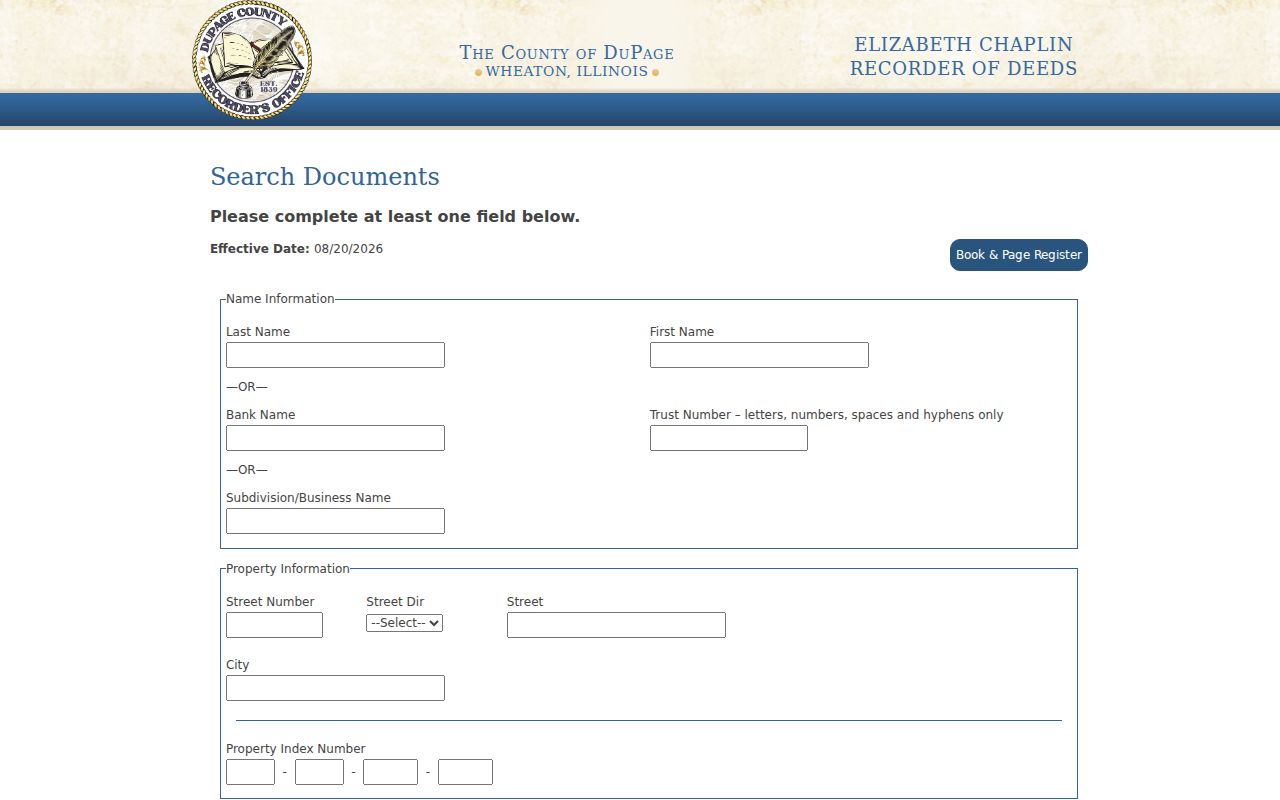
Those fields support a chain of documents, but each party role and instrument date still needs inspection.
Bloomingdale Voter Address Clues
The DuPage voter and address search has name, address, and district routes. The personal route asks for identifying details such as name and birth date with an identity-number alternative. The address route expects house number, street name, and city, and its instructions say to omit the street direction and suffix. Output can identify a precinct, polling place, and political districts without opening a block-wide resident list.
Illinois Election Code section 1A-25 limits voter-file disclosure and requires redaction of sensitive fields. Protected voter rules also matter. A missing public result can reflect a format problem, a stale address, non-registration, or a lawful protection. It should never be read as proof that someone does not live in Bloomingdale.
The county election form makes the separate voter, address, and district paths visible.
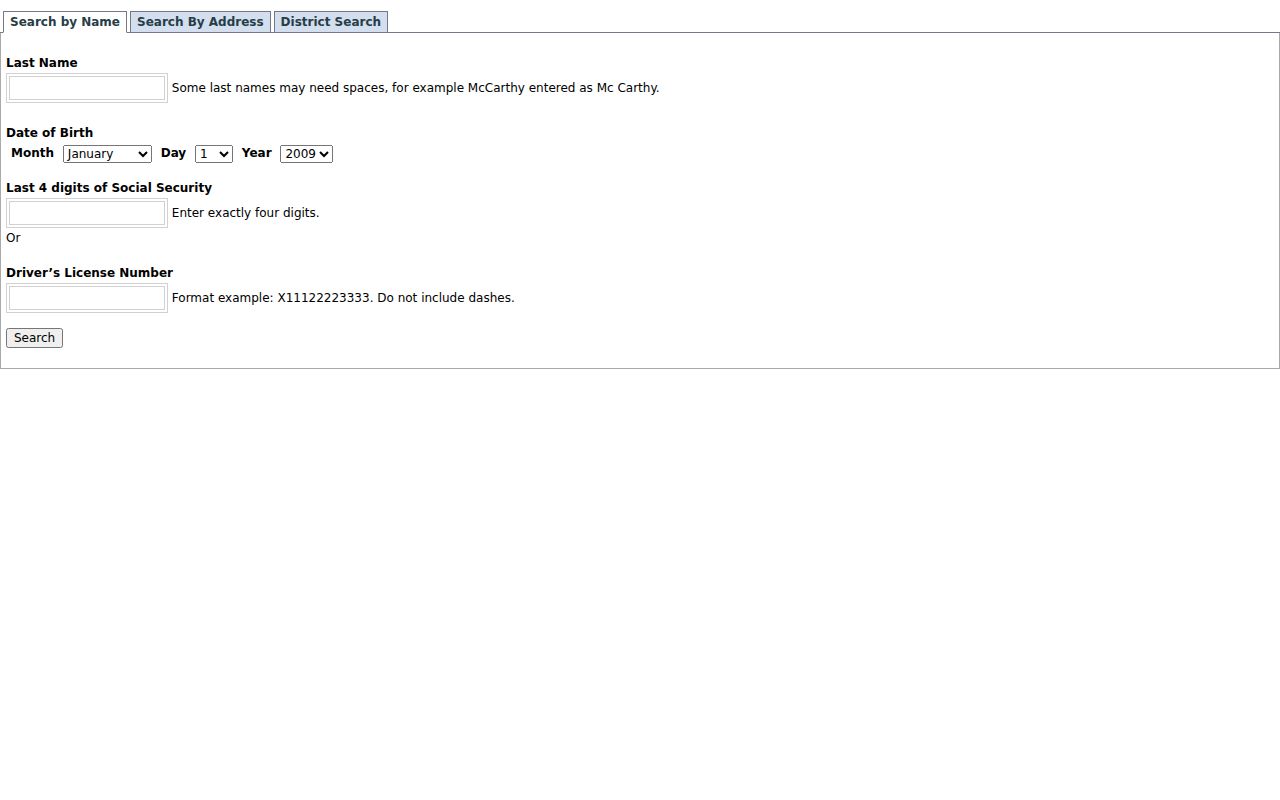
The form's field hints are worth following exactly before treating a no-result response as meaningful.
Current Bloomingdale Resident Rolls
Modern directory work is spread across public indexes with different subjects. Property records name owners or tax recipients. Recorder results name parties to instruments. Election tools confirm voter or district facts under state limits. Court search results concern parties to public cases, not all Bloomingdale residents. Community-group pages identify organizations but do not expose private membership rosters.
| Source | Who It Lists | Keeper | Access |
|---|---|---|---|
| Property roll | Owners and billing names | DuPage County | Free portal |
| Voter lookup | Eligible matching voters | Election Division | Limited public search |
| Recorder index | Parties to deeds and liens | County Recorder | Index and images from 1961 |
| Court index | Parties to public cases | Circuit Court Clerk | Portal or public terminal |
| Community listings | Local groups and contacts | Village and library | Public organization pages |
Choose the roll by the question being asked. An address-to-owner task belongs in the property and deed systems. A name-to-case task belongs with the Circuit Clerk. One-person verification benefits from the fuller Bloomingdale resident lookup workflow, which compares rather than blends these record types.
Bloomingdale Court Party Search
DuPage court records are open during clerk hours unless sealed or impounded. The public-information search offers complaint or ticket, case number, and case-name paths, with status, next date, and docket information. A docket is the chronological list of filings and court events. The system has been moving to eAccess, and human-verification barriers may block an unattended web search.
When the portal fails, the Circuit Clerk provides public terminals at the courthouse. Copies can be ordered through the official I2File route, and certified copies come from the custodian. A name match is evidence only of a case-party record. Check the case number, filing date, party role, and disposition before linking it to a Bloomingdale resident.
The 18th Judicial Circuit record notice explains public access and the terminal fallback.
The official notice keeps sealed and impounded matters outside the public path.
Bloomingdale Certificates and Access
Birth and death certificates are not ordinary Illinois FOIA records. The DuPage County Clerk issues county birth, death, marriage, and civil-union certificates. The county health department holds birth and death records from 1953 onward, while the Illinois Department of Public Health handles statewide records and verification routes. Eligibility, identification, relationship, and record-specific forms control access.
State genealogy rules allow qualifying older records, including birth records at least 75 years old and death records more than 20 years old but not before 1916. DuPage's current page applies a 75-year genealogy threshold to county birth, death, and marriage copies. Marriage and civil-union certificates are public by request through the Clerk; divorce decrees belong with the Circuit Court Clerk.
The DuPage vital-record page sets out request routes and eligibility.
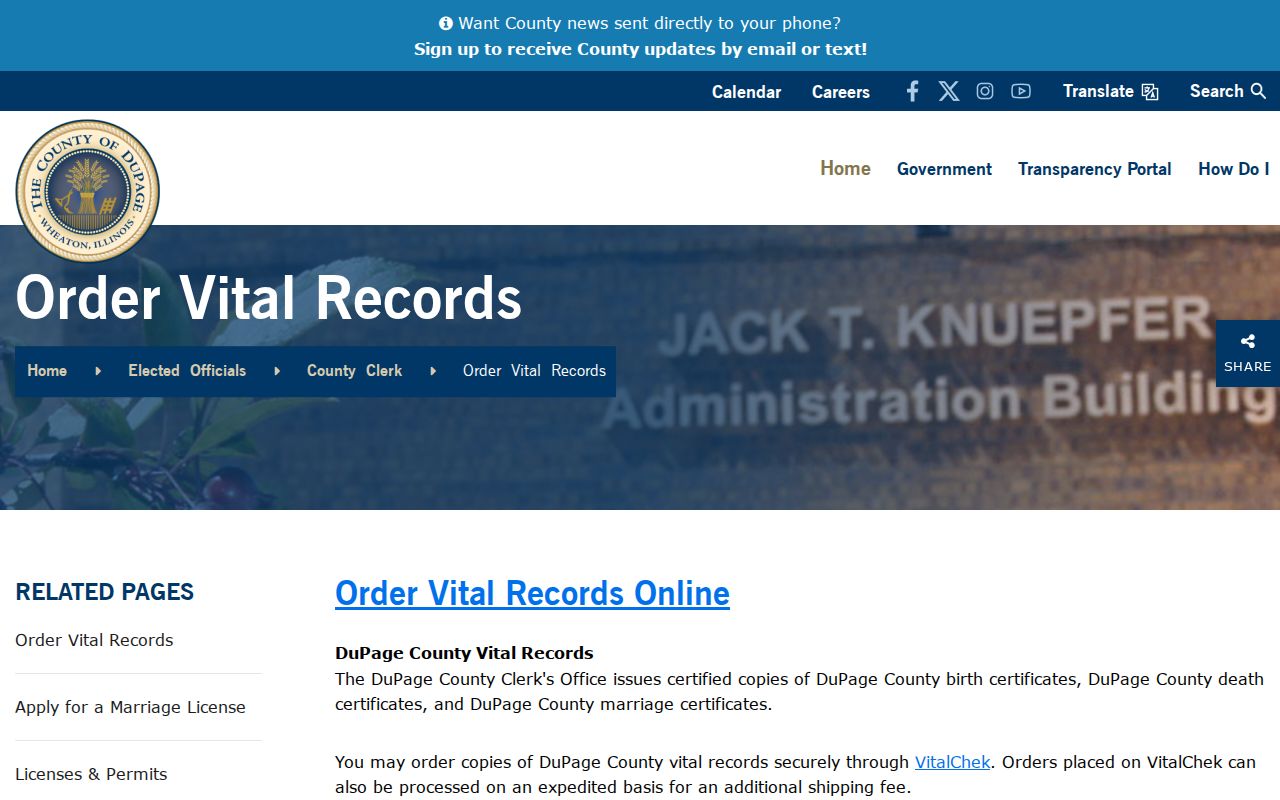
The page demonstrates why a certificate request must begin with the record type and requester's authority.
Historical Bloomingdale Resident Directories
The Bloomingdale Public Library Local History Room keeps maps from 1870 forward, a historic-building index, early-1960s through early-1980s real-estate listings, cemetery and obituary indexes, local minutes, and the Village Almanac from 1975 forward. Wheaton Public Library adds telephone books from 1951 to 2016 and Haines criss-cross directories for later suburban years. A criss-cross directory reverses the usual name order and arranges entries by address or phone.
The digitized Bumstead directory for 1915-16 includes Bloomingdale officials, occupations, businesses, spouses, churches, and societies. An entry may distinguish two people with the same surname through a spouse, trade, or office. OCR text can misread initials and old type, so compare the scan itself. Full collection coverage and reading methods belong in the Bloomingdale city directory.
The library collection page displays the local sources available beyond county portals.
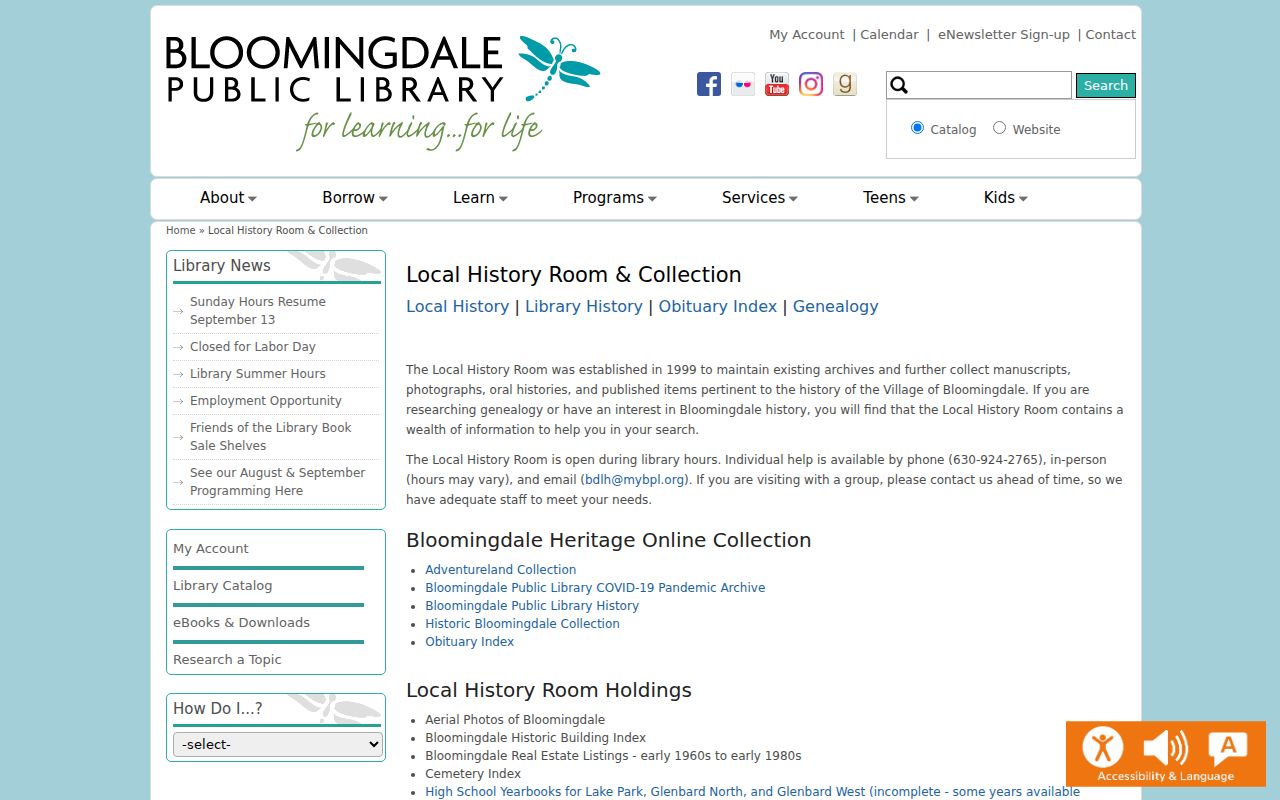
Its holdings connect resident names to buildings, maps, obituaries, and changing address eras.
Bloomingdale FOIA Fallbacks
The Village Archive can be searched by category, keyword, and date for ordinances, budgets, packets, notices, and reports. Building and permit forms are online, but research found no public address-search database for Village permits or code cases. Ask the Administrative Department for the record or use the Village public-record request. Police and general Village records have separate officers, and fire records are referred to the fire protection district.
Illinois FOIA, 5 ILCS 140, generally lets a requester seek existing public records without stating a purpose, subject to exemptions. A focused request names the record type, address or PIN, date range, and likely department. FOIA does not override certificate eligibility, sealed court files, protected voter data, or other specific confidentiality law.
The Village request page shows the correct routing.
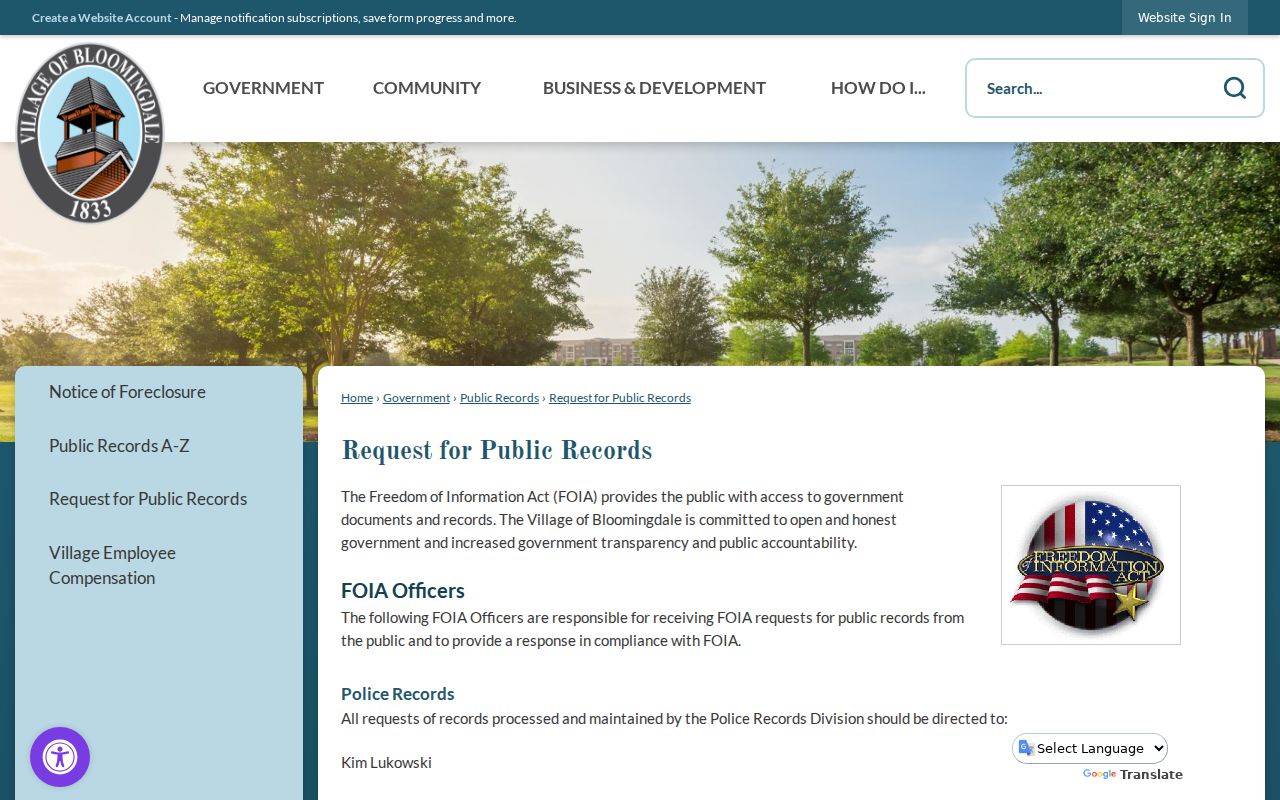
The separate routes help prevent a request from reaching the wrong custodian.
Bloomingdale ZIP and Address Checks
USPS, county, and Village records may describe the same place in different ways. The postal city serves delivery, the parcel situs identifies taxable land, and a Village ordinance may use a PIN or legal description. The official USPS tool can check an exact street address or compare a city and state. Do not treat a ZIP alone as proof of municipal limits or a resident's presence.
The USPS ZIP Code Lookup is the live postal check.
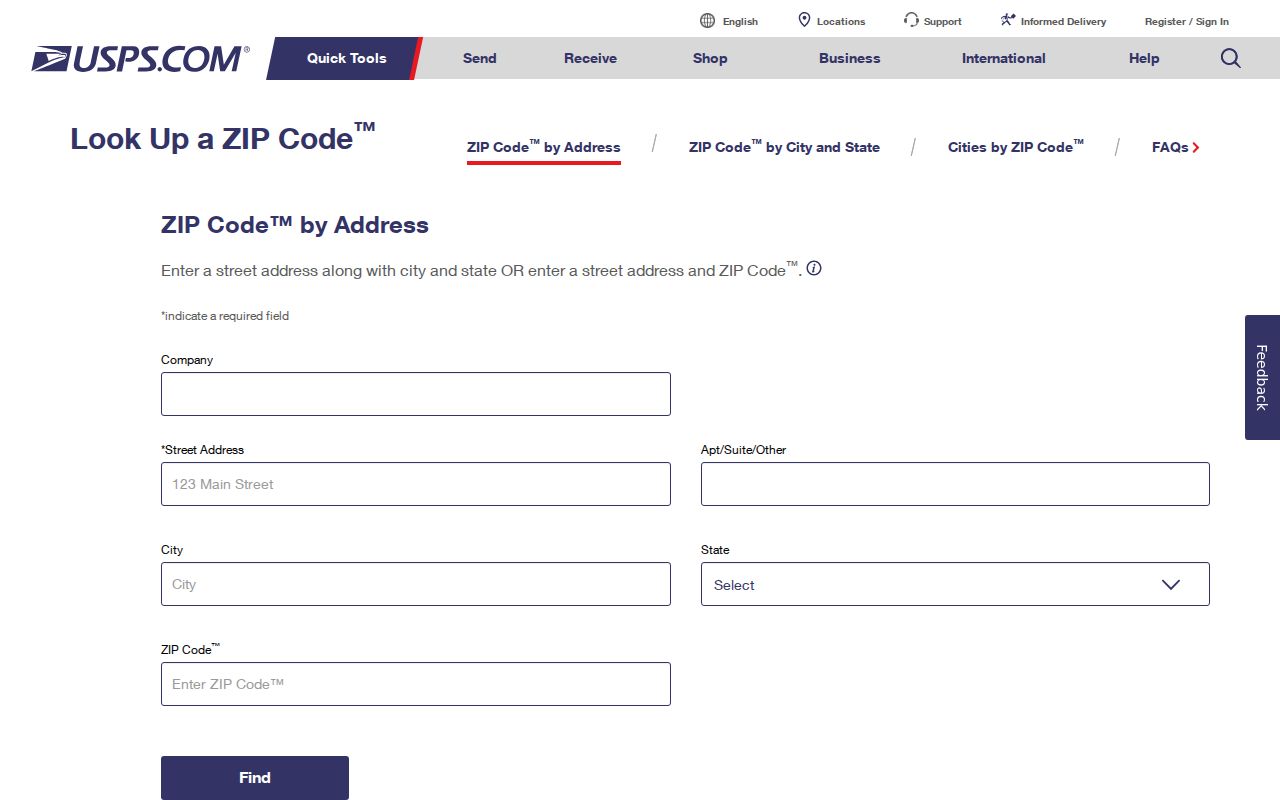
Save the standardized postal result beside the parcel card rather than replacing the county address with it.
Bloomingdale Records Across Eras
Bloomingdale incorporated as a village on June 18, 1923 and was certified that October. Earlier references may sit under Bloomingdale Township, Roselle, Medinah, DuPage County, or a postal label. The library's 1963 Village House Numbering System map is an unusually useful bridge between modern parcel addresses and older listings. It shows an address-management era, though the research did not locate an explicit renumbering ordinance or list of affected streets.
Current records are changing too. The Grove at Bloomingdale, on the former Stratford Square site, has 2025 and 2026 TIF, acquisition, hearing, zoning, and plat documents. A plat of consolidation can alter how lots are described even when local memory uses the former site name. Preserve the PIN, legal description, document number, and map date for a durable residents directory trail.
Practical tip. Save the situs address, billing address, PIN, legal description, and record date as one Bloomingdale search bundle.
Bloomingdale Business Name Connections
A business name can provide a second identifier when a resident appears in a trade, professional, or local approval record. The Illinois Secretary of State Business Entity Search supports business name, registered agent, president, secretary, manager, file number, keyword, and partial-word routes. A result can show the entity's official name, formation or registration date, jurisdiction, status, registered agent, registered office, and named managers or officers. These roles connect a person to an organization. They do not establish that the filing address is a home.
DuPage County's Clerk also handles assumed business names. For a regulated occupation, the IDFPR License Lookup can confirm an individual or entity license and its status. A careful sequence compares the state entity filing, a county assumed-name record when applicable, the Village Archive for license or ordinance action, and the professional license record. Keep the entity, individual, and property roles separate.
The Secretary of State UCC index is narrower. It searches financing notices by debtor personal name, debtor business name, file number, or federal tax-lien fields. Some filing images stay offline because they may contain sensitive numbers. A certified image search uses the official UCC-11 request route, not the public index alone.
Bloomingdale Privacy Boundaries
Some honest searches end at a lawful boundary. The Illinois Address Confidentiality Program gives eligible participants a substitute address for new state and local records, though the Attorney General warns that it cannot ensure confidentiality in real-property records. Voter files have statutory redactions. Driver information is controlled by separate law. Court files may be sealed or impounded. Birth and death certificates require an eligible requester. Each limit belongs to its own custodian and should not be bypassed by combining unrelated data.
Correct an error at its source. A parcel owner or mailing-address issue goes to the assessment office or other named property custodian. A recording-index issue goes to the Recorder. Court-file corrections belong with the Circuit Clerk, and voter records with the Election Division. Commercial search vendors may copy old public data, but they cannot correct an official record. They are not a substitute for a current certified copy.
Lawful personal use. Bloomingdale resident records may support genealogy, estate research, reconnecting, civic review, or checking a seller. Never use them to stalk, harass, threaten, or harm a person.
Bloomingdale's Local Memory Network
Bloomingdale Public Library is the strongest local bridge when a resident disappears between a modern portal and an old county book. Its staff can help locate missing obituary PDFs by phone or email. The cemetery index and obituary index should be checked before a broad name search. The library also maintains the complete Bloomingdale-area listing of clubs, civic groups, and volunteer opportunities referenced by the Village Community Groups page. That public organization layer can establish that a group existed without exposing a private member roster.
Wheaton Public Library extends the search with DuPage census sources, telephone books, city directories, Haines address directories, microfilm, yearbooks, and in-library genealogy databases. The DuPage Historical Museum keeps vertical files, personal papers, real-estate records, maps, city directories, newspapers, photographs, and oral histories. Its archives are available by appointment, and limited staff research may carry a fee after the county-resident free period described in the research.
Search these collections by year as well as by name. Bloomingdale's older sources can use township, neighboring-community, or postal labels. Preserve initials, spouse notations, occupations, street spellings, and the title of the volume. An absence from one edition means only that no entry was found in that source. It does not prove the household had left.