
Bloomingdale Directory Shelves
Bloomingdale city directory research spans several keepers. The earliest verified online volume is county-wide, while the strongest reverse-directory runs sit on shelves in Wheaton. Bloomingdale Public Library supplies the local maps and address files needed to interpret those names. The table separates what is online from what requires a visit or staff request.
| Collection | Years | Where Held | Access |
|---|---|---|---|
| Bumstead's Wheaton City and DuPage County directory | 1915-1916 | Internet Archive and Wheaton Public Library | Free scan and OCR online |
| DuPage County Directory | 1925-1926 | Wheaton Library / Illinois Digital Archives | Digitized catalog item |
| Wheaton city directories | 1940 and 1950 | Wheaton Public Library | Print, in person |
| West Suburban Haines Criss-Cross | 1988-2021 | Wheaton Public Library | Address-order volumes, in person |
| Near West Suburban Haines Criss-Cross | 2004-2021 | Wheaton Public Library | Address-order volumes, in person |
| Telephone books | 1951-2016; suburban microfilm 1920-1971 | Wheaton Public Library | On-site shelf or microfilm |
These are verified holdings, not a promise of an annual Bloomingdale run. A missing year may reflect the publisher's coverage, an unlisted household, or a shelf gap. It does not prove that a family left town. The Wheaton Public Library local-history desk can confirm which suburban volume covers a given year before a trip.
Bloomingdale Local History Room
The Bloomingdale Public Library Local History Room was established in 1999. Its value is broader than a row of city directories. The room keeps a historic-building index, aerial photographs, maps from 1870 forward, early-1960s through early-1980s real-estate listings, cemetery material, incomplete local yearbook runs, municipal minutes, and the Village Almanac from January 1975 forward.
Help is available at 101 Fairfield Way during library hours, in person when staff are available, by phone at 630-924-2765, or by email at bdlh@mybpl.org. Posted library hours are 9 a.m. to 9 p.m. Monday through Thursday, 9 a.m. to 5 p.m. Friday and Saturday, and 1 to 5 p.m. on Sundays from September through May. Call first when the request involves a box, map, or file that may need staff retrieval.
The local files are the best bridge between a name in a county directory and a physical Bloomingdale place. Record the map date, the exact address label, and any subdivision name. That small step helps when later records use a new street number or a different postal label.
Several BPL collections answer questions that an alphabetical volume cannot. The Historic Building Index can connect a surname with a known structure. Aerial photographs help test whether a building existed near the target year. Village minutes and the Almanac may explain a road project, civic role, or neighborhood event. Incomplete Lake Park, Glenbard North, and Glenbard West yearbook runs provide school-era names, but the gaps should be logged rather than silently filled. Online collections titled Historic Bloomingdale, BPL History, Adventureland, and the BPL COVID-19 Pandemic Archive preserve local images and community memory. Ask staff which item has a name index and which must be browsed by date.
Bloomingdale's 1915 Directory Portrait
The digitized Bumstead city directory is both a name source and a compact social record. Its Bloomingdale section lists village officers, churches, ministers, societies, a volunteer fire department, trades, and businesses. C.F. Haseman appears with Rosina and the postmaster role. Other entries identify laborers, carpenters, farmers, a painter, a wagon maker, and a civil engineer and surveyor.
Open the original scan before relying on its searchable text.
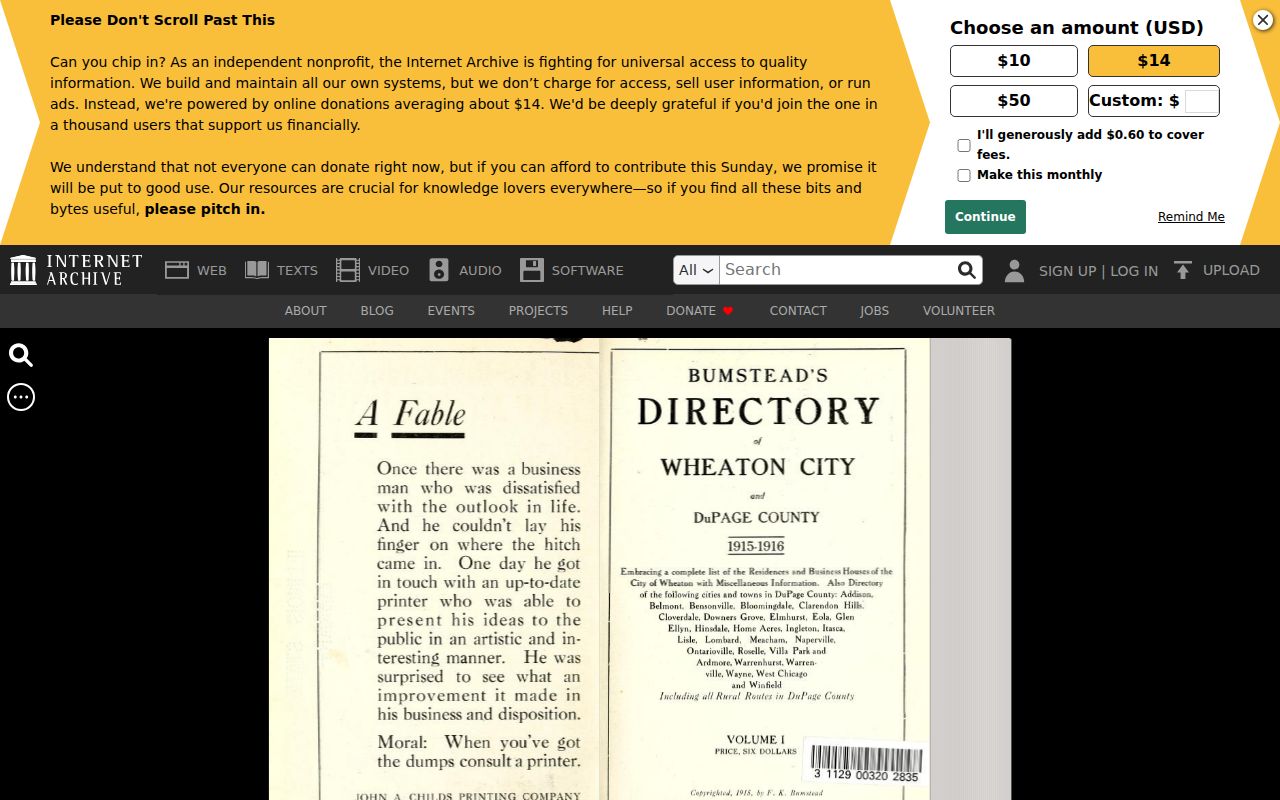
The page image preserves type, initials, and parentheses that OCR can blur. It also shows why an occupation or society may separate two people who share a surname.
Read Bloomingdale Directory Entries
A Bloomingdale city directory entry should be transcribed before it is interpreted. Keep initials, spelling, punctuation, parenthetical names, and shortened trades. Then compare the scan with the OCR text. The Bumstead sample uses compact phrases, so a lost parenthesis can turn a spouse into part of a trade or business name.
| Name | Surname followed by a given name or initial; preserve the printed order. |
|---|---|
| Household | A spouse may appear in parentheses, as Rosina does with C.F. Haseman. |
| Trade or status | Short forms may identify a laborer, carpenter, farmer, retired person, or public role. |
| Business detail | Some listings supply a trade, business address, telephone, or goods sold. |
| Community tie | Offices, churches, societies, and the fire department add identity clues. |
- Criss-cross directory
- A reverse directory arranged by street and house number rather than surname.
- Householder index
- A list keyed to the person responsible for, or listed at, a household.
- Abbreviation key
- The publisher's own guide to shortened occupations, status terms, and address marks.
A current parcel card is far narrower. It may show a billing name and situs address, but the 1915-16 directory places people amid local work, faith, trade, and civic groups. That contrast is why both sources answer different questions.
DuPage Directory Research Options
The DuPage Historical Museum Research Library adds city directories, maps and plat books, newspapers, personal papers, organization records, and real-estate files from the 1950s through the 1970s. Research is on site, and archival work is by appointment. A limited staff service accepts an online form, mail, or a front-desk request.
Review the museum's research and reproduction terms before submitting a request.
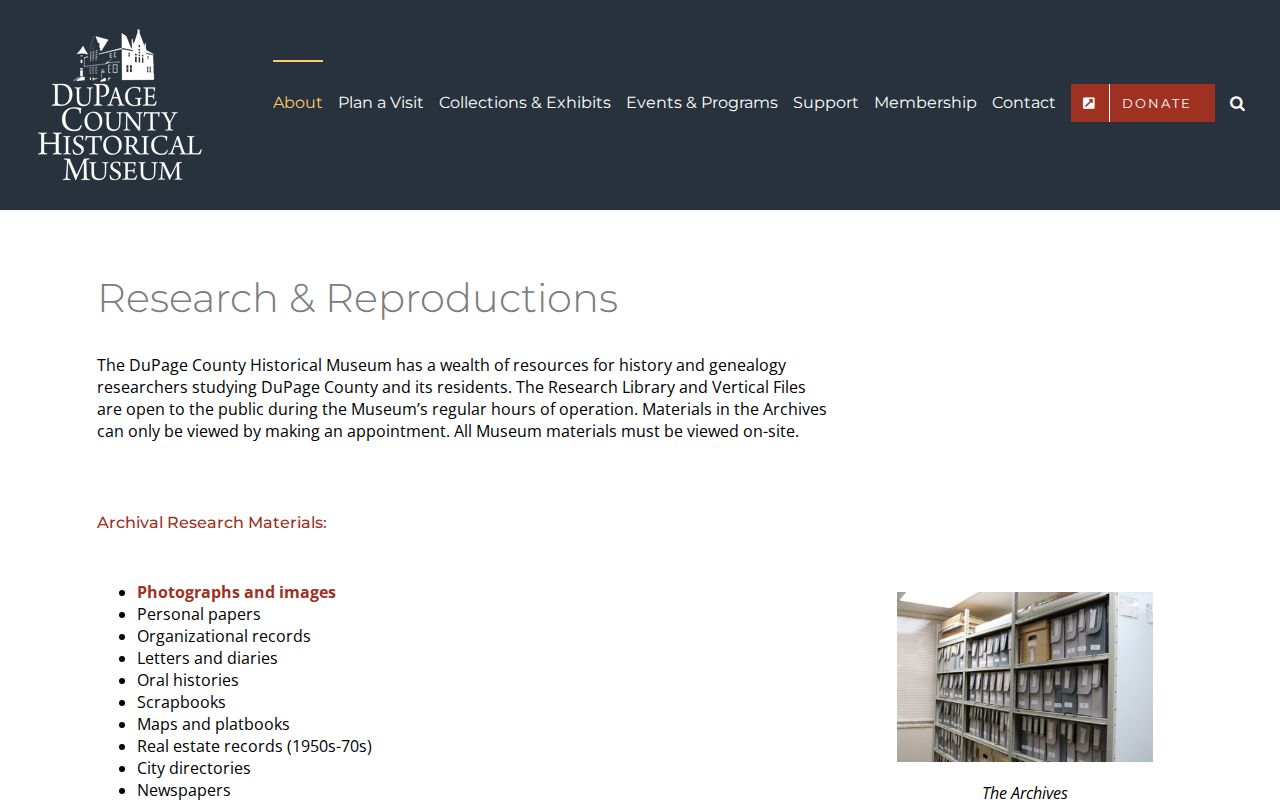
The captured page shows the county-scale option when a Bloomingdale name is absent from a library volume. Staff research may take up to two weeks. DuPage residents receive the first 30 minutes free, then the rate is $25 per added hour; non-county research is $25 per hour. Standard black-and-white copies are listed at ten cents per sheet, and reproduction orders may take up to three weeks.
A focused museum request should state the full name, spelling variants, Bloomingdale address or subdivision, and a narrow year range. Mention the exact resource type, such as a directory, real-estate file, plat book, biography file, or newspaper clipping. The museum also holds organizational records, oral histories, letters, diaries, and personal papers. Those sources may explain a civic or family connection that a directory reduces to one short line. Because the archives require an appointment, confirm access before traveling and distinguish a request to inspect material from an order for a reproduction.
Bloomingdale Directory Newspaper Checks
A directory gives a terse entry. A local paper may explain it. The Illinois Newspaper Project's Bloomingdale listing catalogs titles including the Bloomingdale Examiner, Press, Star, Voice, Village News, and related editions. Some catalog dates contain the letter “u,” which marks an unknown digit. Keep that uncertainty instead of expanding it into a guessed year.
Check the cataloged title and date range at the project page.
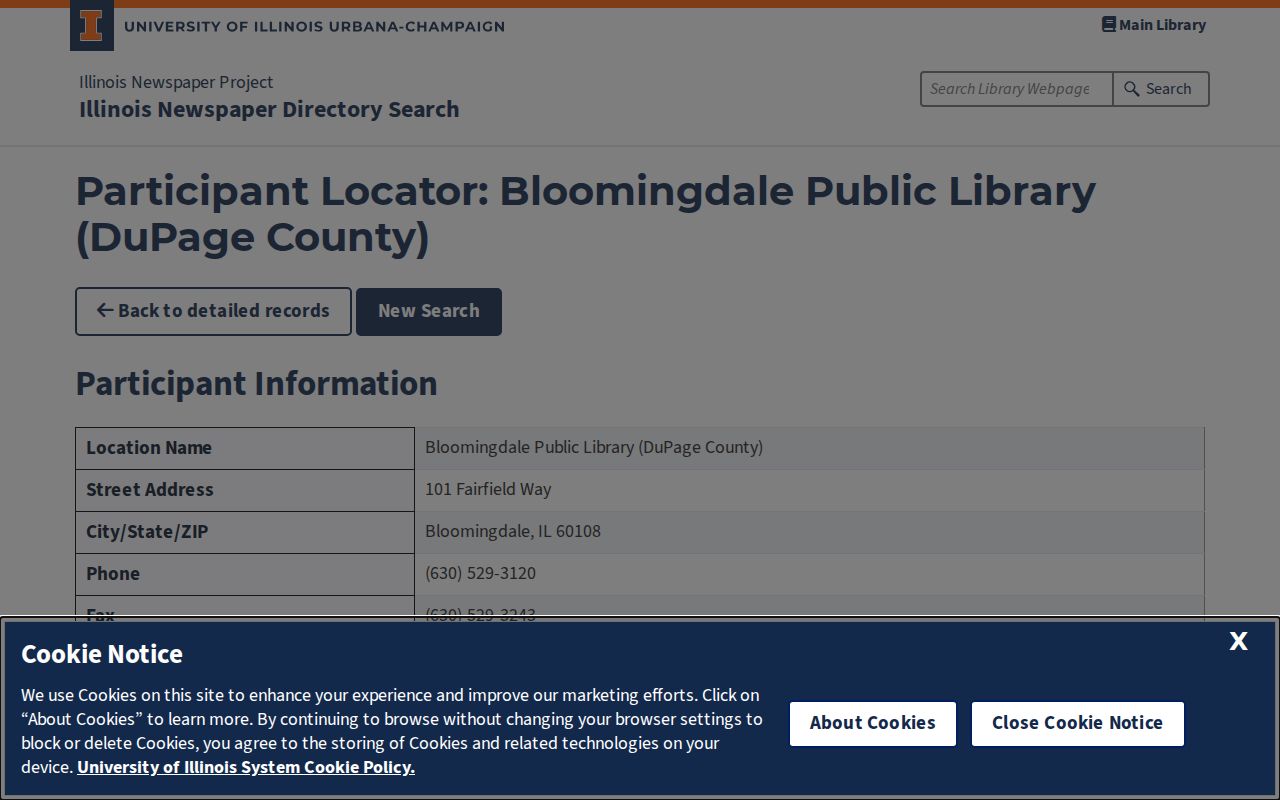
The catalog view identifies the holding institution, but it does not mean every issue is digitized. Contact BPL at 630-529-3120 or bdref@mybpl.org to confirm a date and access method.
Bloomingdale Directory Address Maps
BPL maps run from 1870 to the present. One unusually useful item is the 1963 Village of Bloomingdale House Numbering System map. Nearby dated holdings include 1958 street maps, a 1959 plat map, 1961 telephone-plan and topographic material, 1965 township maps, 1967 plats, and later house-number and zoning maps.
The 1963 map is evidence of an address-management system, not proof that every street changed that year. No source in the research identified a blanket renumbering ordinance. Match the old map to cross streets, subdivision or lot details, and the directory year. BPL's early-1960s through early-1980s real-estate listings can add a name or listing clue during the village's rapid postwar growth.
Jurisdiction labels also matter. DuPage County formed in 1839, Bloomingdale Township was established in 1849, and Bloomingdale incorporated separately as a village in 1923. An early resident may therefore be filed under the township, county, Roselle, Medinah, or a postal label instead of the modern village name. Search those variants one at a time. The village's railroad-era and postwar growth also changed which county and suburban books were useful. Preserve the label used by each source, since replacing it with a modern name can hide why two otherwise matching entries look different.
Note: Preserve both the old label and the modern address until a dated map or plat proves they refer to the same site.
Trace Bloomingdale Families by Directory
Family history works best when a Bloomingdale city directory is treated as one dated observation. The census is another. A phone book, map, obituary, or real-estate file may sit between them. Their dates and rules differ, so agreement among two or more sources is stronger than one isolated name.
- Begin with the best-known name, address, and approximate year. Search initials and spouse names as variants.
- Move across the verified directory editions. Record each address or trade change without assuming why it changed.
- For later years, use a Haines criss-cross volume to turn an address back into a listed name.
- Compare the closest released census schedule, while remembering that a census records one enumeration date.
- Use BPL's obituary and cemetery indexes, newspapers, or museum files to test why a name vanished.
The public BPL Obituary Index is alphabetical, and some entries link to a PDF. For an entry without a PDF, the library invites a phone or email request. A missing directory listing may mean a move, death, unlisted telephone, coverage gap, or spelling problem. It is not a conclusion by itself.
DuPage census holdings documented at Wheaton include print schedules for 1840 through 1870 and microfilm for 1860 through 1880, 1910, and 1930. The library also lists an 1865 Illinois State Census. Pairing these with directory years gives a measured timeline, not a continuous annual roll.
Churches and societies can supply one more check. The 1915-16 Bloomingdale section names Baptist and Lutheran communities, ministers, fraternal groups, and the volunteer fire department, although no complete online membership register was verified. Search the organization name with the person's name and year in BPL or museum files. For naturalization and older local-government records, use the Illinois State Archives and IRAD repository route. Confirm an exact collection title before assuming it holds the person sought.